Thursday, 15 March 2018

Learning Environments

"My classroom is my students' classroom"
A great way to establish a culture of student voice is to have students design their classroom from the beginning of the year. My Gr 5 and 6 students have had ownership of their classroom design and have created spaces within it to meet their learning needs and styles. Not only was there a culture of student voice established but student choice too! After designing the classroom, students wanted to create different "zones" within their classroom after being introduced to "zones" within their open concept Gr 6 classroom (Mrs Silva and Mrs Fortier). We created a list of "zones" and "needs updating" in and around our classroom. Student then chose what they wanted to work on. This list consisted of lighting, plants, decorating classroom door and others!
"As a teacher, I am passionate about listening to my students and making sure their voices are being heard and considered. Their ideas have initiated the collaborative plans for our room, where we then worked together to create physical learning spaces. Learning opportunities such as these are valuable because the students are being invested in their learning." -Yolanta
Here are resources that I used when researching how to have students design my classroom: Stuart Shanker's Self-Reg Classroom Environment Reflection Tool and Stuart Shanker's Self-Reg Classroom Environment Reflection Tool Checklist from The Mehrit Centre.
Here is a documented process of how we transformed our classroom:


After the spaces were created, they became modified throughout the year based on feedback by the students. Students have become familiar with the spaces and the flexibility to work in the different areas. The spaces are set up for different learning styles or for different learning tasks (e.g., collaborative or independent work, calm, active). By providing these spaces in the classroom and giving students the opportunity to use them, they become more aware of  their personal learning styles and learning needs. Students begin to develop self-regulation skills, which is an important part of the equation that enables the deep learning. Deep learning will only happen if students feel safe, confident and comfortable within their learning environment. Students become more active and willing to take risks in their learning when their environment enable them to do so.  

My class was lucky to have our school board film them working in their learning environments as part of a Deep Learning serie:


A story of Resilience, Strength and Passion

Chris Nihmey; Author, Teacher, Mental Illness Advocate, Survivor, and Public Speaker!


On Feb 27th, St. Elizabeth Ann Seton's grade 3-6 students were very fortunate to listen to Chris present a heartwarming story about his friend Michael's struggle with mental illness. Chris' connection with the students, his humour, his strength, his emotion and his passion drew every single student in. With amazement they listened to his every word and he had them all eating from the palm of his hand. The look of shock and surprise on their faces was unbelievable, when one of his last slides was a picture of his friend Michael, Chris Michael Nihmey.


Chris is one of the faces for CAMIMH (Canadian Alliance on Mental Illness and Mental Health). As one of the ambassadors Chris is joining in on the fight and is hoping to destroy the stigma of mental illness. His focus is to educate, increase awareness and understanding of this illness. His hope is that when this is achieved, there can be compassion and acceptance.


Tuesday, 27 February 2018

What is a MakerSpace? by Michelle Sherwin

What is a MakerSpace?
A place where people can invent, create and collaborate using information, resources, and tools, all done through playing, tinkering, and exploration.

When I first saw the Learning Commons at St. Elizabeth Ann Seton, I saw an amazing space with great potential. Having maker-designed a number of LC spaces previous to SEAS, the vision was instant and very clear. What I thought was needed was micro spaces. Areas were groups of students and/or staff could work collaboratively on a project or activity without disrupting each other. The size of the room was perfect for this design.

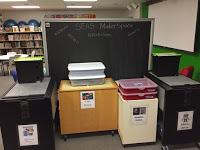
Alexa, their current Library Tech, was keen to get started. She too could see the potential but like many, the task seemed huge and overwhelming for just one person. What she needed to know was that she wasn’t alone. The staff had already put together 4 portable MakerStations - Robotics, Lego, Invention and Audiovisual. All were loaded with perfect resources and ready to roll. We had a plan and with some assistance and muscle we were ready to dig in.

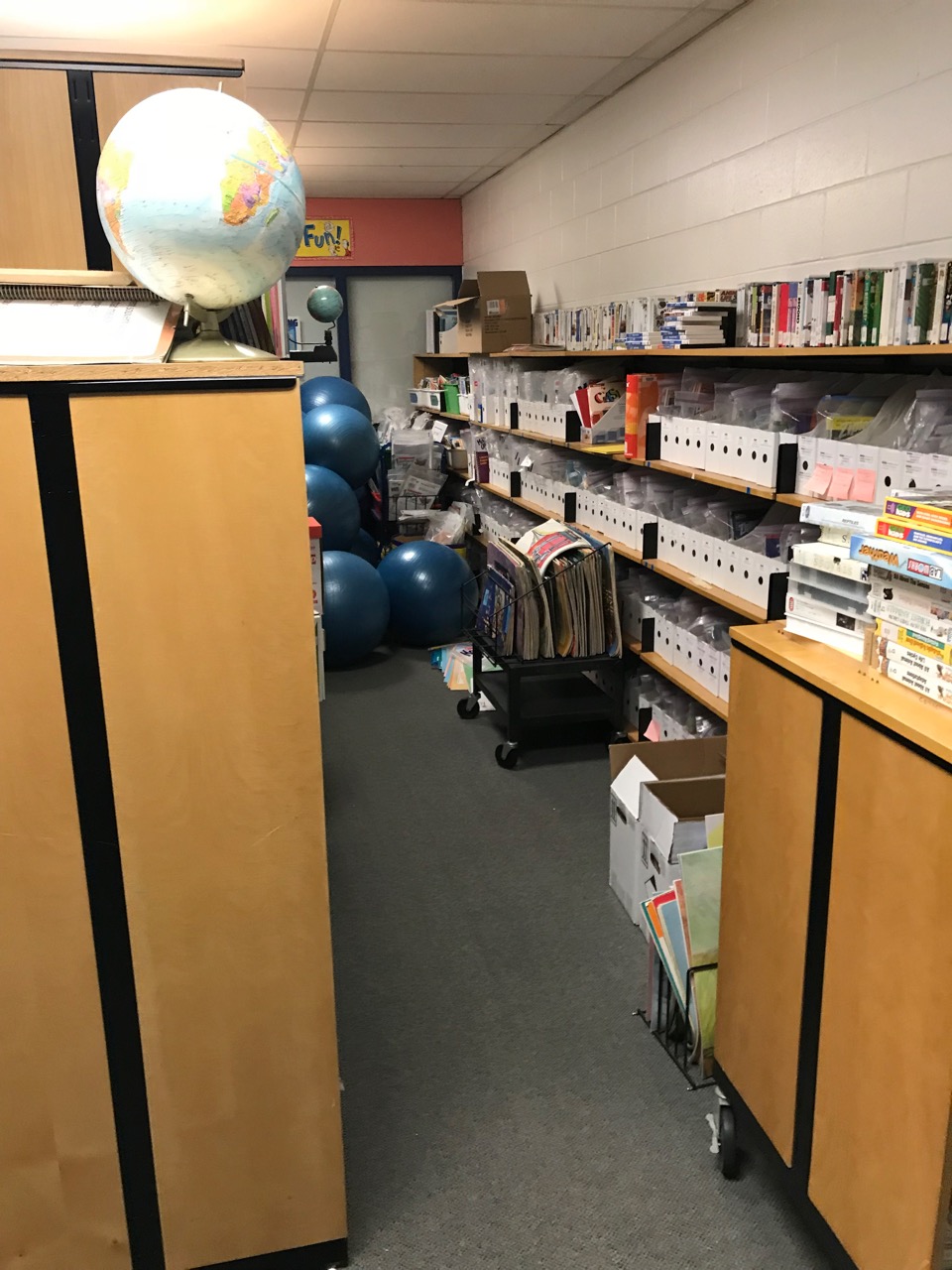
Books were moved and grouped together in common areas. Teacher resources were moved to a more out of the way space were staff could work collaboratively in private, close to the needed materials. Shelves were arranged to make area dividers. Tables were moved out. Too much furniture can impede with the need for open spaces that play, tinkering and exploration require. The furniture that was kept was set up in such a way that is was flexible to allow for large group meetings or small separate work spaces. In 6 hours...Voila...a new space that met all of the needs of the staff, students, Learning Commons and MakerSpace.

Thank you for letting me be a part of your Maker transformation journey.


Michelle Sherwin 
(Library Tech at Our Lady of Peace and St. Luke's Ottawa)
BEFORE


AFTER


Thursday, 15 February 2018

Maker Mobile

While the finished product was our main goal, so much more came out of our afternoon of creating our maker mobile. A lot of research was required into what we would need to create our 4 carts. Through our TLLP budget we were able to purchase many of the necessary items such as Lego, microphones, tripods, makey makey, chromebooks, iPads, Tech Tubs etc. With the help of a Library Technician from another school (Michelle Sherwin) who has put together many carts we came up with a plan. Our job was to convert 4 pieces of furniture into 4 Maker Mobile Carts.


The hardest job was gutting an old netbook cart. A hammer was needed and a few cuts and bruises were had, but the satisfaction Nadia and I got from taking out almost every piece in order to create something from nothing was worth it. We turned the netbook cart into the Robotics Station because we were able to lock up the valuable items such as the Ozobots, Beebots, Sphero and Dash & Dot.
The Lego Station was converted from a wooden Library poster cart. They were able to secure Lego boards to the outside and store the Lego in 4 bins on the inside. We converted a portable desk into the Invention Station. We collected a lot items from staff and students and purchased the basics such as storage bins, scissors, markers, and tape to finalize it.


Lastly, Laura and Michelle repurposed an old wooden desk by attaching wheels, a lock to secure the more valuable items and removed another section in order to store the tech tub filled with chromebooks and iPads.


The best part of the day was the communication and teamwork that went into making these 4 carts and realizing a year long dream of bringing Maker Mobile stations to SEAS. There was great satisfaction in having a physical end product at the end of our afternoon together.


~ Juliana Lacelle


Monday, 22 January 2018

#seaspen Parent Engagement Night

Our school staff wanted to engage our parent community in learning more about a number of initiatives connected to our SIP and TLLP goals that promote the social emotional learning of students. Our Parent Engagement Night was held on November 29, 2017 and offered parents 4 sessions. We promoted our event using Twitter, Synervoice, a hardcopy pamphlet and a Google sign up form.

The sessions included Zones of Regulation, Flexible Seating and Community Circles, Exploring Math in Today’s Classroom and Hapara Workspace. The sessions were offered by school staff with support from school administration and the School Board Leading and Learning team.


Zones of Regulation explained the relationship of self-regulation to stress response, brain function, stressors and calming strategies. Up regulating and down regulating activities were explored.


Flexible Seating and Community Circles focussed on the research and rationale behind both flexible seating and community circles, and their link to creating a climate and culture of collaboration, connectedness and empathy. 


Exploring Math in Today's Classroom allowed parents an opportunity to more fully understand math in the K-6 classroom and participate in some math games and puzzles that enhance numeracy, logical thinking and spatial awareness. 


Hapara Workspace introduced parents to an online secure platform used to create a personalized learning experience for students that deepens collaboration and differentiation.


The parents arrived excited to learn and were able to visit two sessions. The feedback from parents was very positive. A second session is planned for the spring with hopes to showcase our school makerspace and demonstrate how makerpsace activities provide positive social emotional learning opportunities that link to the curriculum. 

~Laura 

Saturday, 6 January 2018

Our Makerspace is on the Move!

A gathering of our school professional learning community (PLC) was organized by our school administration (working closely with the TLLP team, with TLLP and SIP goals in mind) for early December, 2017. We were fortunate to have the coordinator of the OCSB’s ‘Leading and Learning’ department as our workshop leader, with input and resources from other members of the Leading and Learning team. The focus of the day was Makerspace, which was an exciting moment for our TLLP project as it marked an important next step in the evolution of our school’s learning environment changes.


Our TLLP team had completed some work on learning environment changes earlier that same week, repurposing carts and school materials while also incorporating items from our TLLP budget. You can read about this process further in a separate blog post to come! The creation of four Makerspace station carts, as well as curating and creating activities is a process that necessitates a whole-school approach. While some teachers already feel comfortable using design thinking with their students and supporting other teachers in this journey, others may be engaging with the process for the first time - trying out or designing their own Makerspace activities. This process was facilitated by our workshop presenter’s creation of a slidedeck that included multi-disciplinary Makerspace tasks to try out collaboratively. We were given the opportunity to rotate through tasks at each of four stations (Invention / Construction Zone, Audio-Visual, Lego, and Robotics). At the end of the rotations, teachers had time to think about curriculum links and the types of activities they might like to use with our own students. These ideas have been added to the slidedeck and this growing document will be a testament to our growth as educators as our school community engages more deeply with a maker mindset shift.


As a next step, our TLLP team hopes to further investigate the idea of SEL-centered makerspace tasks that prompt students to think more deeply and critically about their emotional regulation as they express their creativity. One specific example of such an activity asks students to reflect on their SEL knowledge and create a house structure that reflects one of the zones. For example, if the student group chooses the red zone,they must consider what a ‘red’ structure would look like. Students must think about the feelings that fit with that zone, and how those feelings mesh with the big ideas of strength and stability of structure. Social-emotional learning may also be integrated into future Makerspace activities with the use of student self-assessment in terms of their feelings surrounding collaboration, creating, and goal-setting. As we continue our book study of Launch (Spencer, Juliani, 2016) our engagement with the “Launch Cycle” (page 54) will hopefully appeal to our colleagues who are moving along on their own Makerspace and SEL journeys.

~Katie

Thursday, 4 January 2018

We have narrowed our Focus!

  Our first meeting in September was a success! We started off leading by example with discussing our thoughts and highlights of the first couple of weeks in an informal community circle, as we do in our classrooms. We had many stories to share especially the success of the 5 in 10 school wide initiative. This initiate is explained more in another post .


  What we accomplished from this meeting was a lengthy discussion about our large topic, Social Emotional Learning (SEL) and how it connects to Deep Learning (DL). Below you can see the visual (spiral) we as a team derived based on all the important aspects we were going to focus on such as collaboration (one of the 6 C's), our community (staff and students), self-regulation learning skill, partnerships, leveraging digital and classroom environments.
  We knew that SEL is the foundation of our project and it should be the foundation for any students' journey into deep learning. This is why it is at the centre, the core of our spiral. Through SEL, a student is able to self-regulate appropriately in order for deep learning to happen. However there are other conditions that have to be met along the way. As a team, we are going to focus on and collect data about collaboration as one of the 6C's of the global competencies. We understand that having most or all the 6C's is necessary to achieve deep learning. While most C's will be achieved through many of our classroom or school-wide activities, projects, units etc. Only collaboration will be getting a closer look through the New Pedagogies for Deep Learning progression chart.
  There are three dimensions within the progression chart that we believe are an integral part of connecting SEL and DL. This is why it belongs within the spiral. Leveraging digital (technology - innovative practices), partnerships (students, teachers, parents) and environments (classroom, school, digital) are factors that will influence how students learn. Each of us will be looking at these "dimensions" and apply them within our classrooms to enhance and foster SEL so that students can learn on a deeper level.

~Yolanta

Tuesday, 14 November 2017

SEAS 5 in 10 Day Challenge


Collaboration at its best!


Our SEAS 5 in 10 Day Challenge was anchored in the New Pedagogies of Deep Learning.  Our thinking was that if we, as a school, give our students a wide-spread, consistent message then the language connected to these initiatives will be applied not only in our own individual classroom but also everywhere within and outside of the school.

~Nadia & Julie

Sunday, 5 November 2017

The beginning of our TLLP journey

When our team was first introduced to this project, we had no idea what we were signing up for ;) We knew what goals and expectations we wanted to attain for our school community, but we didn't know all the details. When we first applied, we added as many expectations and goals that we could in order to be accepted, but we soon realized the magnitude of this project would also be professionally challenging, in a good way.
Luckily our team is an amazing one and we all put forth 100% effort. The beginning has been difficult because we have been grappling with the idea of a main focus for our project. This has been our first major challenge even though we hadn't even started the 2017-18 school year. Katie Brown and I (Yolanta) participated in the TLLP conference in Toronto where we received a thorough understand of what TLLP entailed. After this experience, Katie and I knew that our project was much more than what we had expected. Even if this was going to be a HUGE undertaking, we knew our team could take this on! What we didn't realize was how this project was not only going to benefit our school community but was going to be a professional journey and taking on a lead role in our own learning.
Here is a video from our first meeting (June 2017) where we captured how we felt before embarking on our journey together:

It was during this first meeting that Katie and I had introduced our project's infographic. We wanted a visual that best represented the goals of our project, but we were not completely satisfied with the result. Ever since our project was accepted, we have been having trouble narrowing our focus and goals of the project. This is our initial infographic explaining our main goals.


~Yolanta
SaveSave