Monday, 9 April 2018

SEL Musical

SEL Play - Can You Tell Me How To?


The Grade 3 classes collaborated to produce a Musical Play based on social
emotional learning (SEL). Each character had a challenge to overcome such
as learning to read or dance, or accepting oneself. The music lyrics provided
motivation, encouragement and acceptance. We even had a guest appearance
by our school principal, Jody Prevost. The play was presented to the students
in Kindergarten to Grade 2, and parents were also invited to watch. Our
school has been involved in many activities that promote SEL, and through
media literacy, drama and music we were able to link our SEL Musical directly
to the curriculum.


         Media Literacy Link                                      Audience Feedback

Cross-curricular SEL Activity - Grade 3 by Melanie Harkes

The Greedy Triangle SEL Activity
by Melanie Harkes - Teacher Candidate @ Nipissing University

The greedy triangle activity was a great way to integrate geometry, SEL and language.
We started with a read aloud of the book, “The Greedy Triangle” by: Marilyn Burns.
The book was about a triangle that was dissatisfied and continued to change his shape.
At the end of the book the children realized the triangle was much happier being himself
than any other shape. The students were able to make connections and explain that
sometimes people want to be different, but in the end we have to appreciate who we are.
We shared different character traits and what zone of regulation they would be
associated with and why. The students got very creative and came up with some great
“personality polygons”, like awesome arrow, sad square, tired triangle, respectful
rectangle and so much more.
For the next part of the activity the student wrote an explanatory paragraph, which
would explain their polygon and its associated personality trait. They had to specify why
their shape was considered a polygon, which furthered their understanding of geometric
shapes. They often wrote about what zone of regulation their polygon was in and why.
The students really enjoyed this activity and they were able to tie together geometry
and social emotional learning with literacy. It was great to have an activity that not
only developed their skills academically, but socially and emotionally as well.


SEL Activities - Grade 3 by Shayla Pierre

SEL Activities
Shayla Pierre – Teacher Candidate @ University of Ottawa


I was lucky enough to have my final placement as a teacher candidate in Laura Cress’
grade 3 classroom. I learned so much from being a part of the classroom environment
from September-January. I think one thing that stood out the most was the amount of
emphasis that not only Laura but that the school put on mindfulness, SEL and student’s
overall well-being. Student success is what we all strive for as educators and I really
believe that working on a student’s well-being is setting them up to be successful.
One specific example that I was a part of during my time there was a SEL Sesame
Street play. The whole message surrounding the play was to try even if you don’t succeed
right away and to be happy with who you are as a person. The topic of SEL is so
important for us to foster in children from an early age. It is important for them to
understand their emotions and understand how to deal with them. In the play we saw
that Big Bird couldn’t read a really long word and she just didn’t give up. Although it was
frustrating to not know something right away with patience, time and some help Big Bird
was able to read the word. As well as Grover, he wanted to learn to dance and was sad
that he couldn’t but with help from his friends he was able to. The play was presented
for the students from kindergarten-grade 2 and I think that it was a great message for
them to hear and learn in a fun and engaging manner.


Another example of a mindfulness activity that we did in class was something called a
positive self-talk flower. The students were given a template of a flower with 6 petals
and about 100 different options that they could write on the flower for when they
needed some encouragement. Some of the messages were “I am smart”, “I am beautiful”,
“My voice matters”. All of which were important messages that the students could apply
to their everyday life. I think it’s so important for students to take control of their feel
ings and emotions and the positive self-talk flowers were a great way for them to have
those reminders.

Indigenous Education- Deep Learning


Indigenous Education -Deep Learning


Our Indigenous Education Journey started in August when my teaching partner and I decided to team teach 48 grade 6 students. We designed our room around a central "Community Circle". Our vision was to have a sacred area in the classroom where the students could engage in the sacred ritual of circle as well as a nearby prayer table to represent our liturgical season.


The year started off with the students driven by many wonderings; The meanings behind  Dream Catchers and the reasons behind Restorative Circles. Using the design process the students researched as well as created their own dreamcatcher that representes who they are.


The Grade 6 students took an excursion to Mosaïc Canada in early fall to support their French Social Studies Program. The gardens provoked their thinking of Canadian Identity which includes Indigenous culture. The students were engaged in the opportunity to build their knowledge about local community and indigenous history, culture, music and sport. They explored the experiences and perspectives of the Botanical Sculptures that represented the communities within Canada. They examined how all First Nations contributed to the development of Canadian Identity.


As the children continued to learn about Indigenous Peoples in Canada their inquiry led them to Residential Schools.  "I Am Not a Number" by Jenny Kay Dupuis and Kathy Kacer is a picture book based on a true story about a young First Nations girl who was sent to a residential school. After the classroom read aloud the students journaled about the story and reflected upon how they felt after learning about this part of our history and how the truth was hidden from us.


This led to research about the Truth and Reconciliation between Indigenous Peoples of Canada and Canadians. The grade 6 students were connecting Point of Views to Canadian residential schools. Their activation question was; Whose point of View could they consider during this tragic part of Canada's history?

Through the Seven Grandfather Teachings our Collaborative Inquiry discovered the wisdom of community partnerships by inviting our School Board (OCSB)  First Nations, Metis and Inuit Learning Partner; Daphane Sandre.
Her knowledge of restorative practices,
seven teachings and the links to our Catholic Virtues supported the students learning and actively engaged
them in Indigenous Education.


The students participated in a powerful Blanket Exercise that immersed the children through pre-contact, treaty-making, colonization and resistance of the indigenous peoples of Canada. The goal was to educate empathy for the Indigenous peoples.


Students continued their Indigenous Education through other disciplines in French: Social Studies, Visual Arts, Science and Music.


Students were first introduced to Gord Downie's The Secret Path as part of the Social Studies curriculum. We watched the parts of the animation portion only - pausing and discussing the imagery and making connections to their introduction of Indigenous education and reconciliation.


The imagery and animation of The Secret Path captivated and triggered students' emotions.

The Team at St. Leonard Elementary School

Our TLLP is extended to teachers at another elementary school within our board, St Leonard. We have been fortunate to keep the Learning Partnership active as much as possible. Here is a summary of what they have been up to:

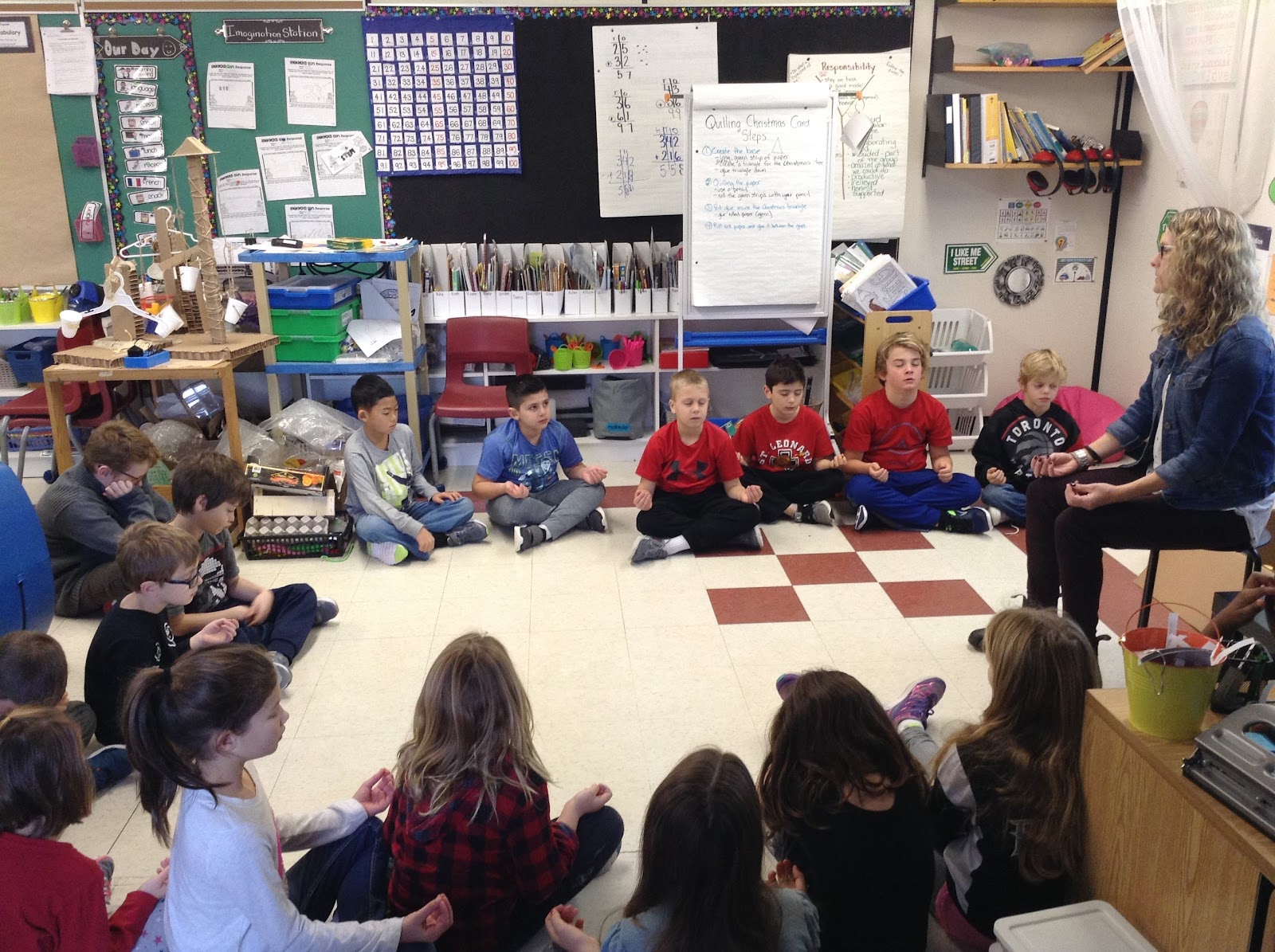
We are a team of three educators, from St. Leonard school, who are passionate about inquiry learning and building capacity in deep learning. Through our experiences over the last few years we have come to understand that students are better equipped for inquiry learning and developing global competencies when they have a basis of social-emotional learning skills. This year we dedicated the first few months of school to the explicit teaching of self-regulation skills using Conscious Discipline, Mindmasters and Zen Den activities from Cosmic Kids. We used the Zen Den videos to learn and discuss various strategies so students were better able to understand what their bodies feel like when they are in an optimal learning zone. Follow this link to access the library of Youtube Videos goo.gl/fRw016. 


Our initial observations have confirmed that with these self-regulation skills students are better able to negotiate the demands of deep learning through inquiry and design thinking. Our students are using the self-regulation strategies to demonstrate a growth mindset and be active contributors to the classroom learning environment. They have grown to be accountable in collaborative discussion, accepting their responsibilities to the learning environment, engaging in self and peer feedback and advocating for their learning needs


~Bonnie Caminiti and the teachers at St. Leonard

Deep Learning in our District

This is a pasted portion of the article that focuses on the Deep Learning initiative within our district. Please see link below for the full article


OTTAWA CATHOLIC SCHOOL BOARD (OCSB)

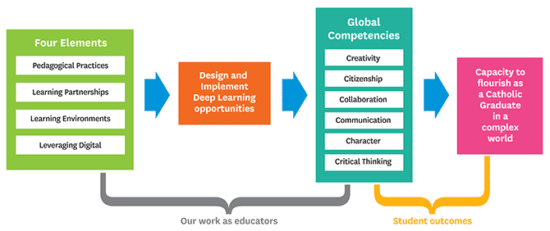
The OCSB has 84 schools and about 41,000 students. They joined our Deep Learning initiative three years ago, immediately developing a plan for system-wide change. They moved from seven schools to 21 to all 83 schools. I don’t have the space to describe the multiple strands of communication and involvement that characterized the change, but let’s just say it was systematic and two-way within the district in its deliberations. The essence of the model is displayed in Figure 1, which is essentially our model from Deep Learning, but I use OCSB’s version here.
Figure 1
Here is an example of the strategy: “Each month the board has a common focus that is shared across all 83 schools at the monthly staff meetings. Over the ten-month school year, all four learning elements and all six global competencies will be explored in every school” (interview with district leaders). Multiple overlapping ideas are used and reinforced through interaction and digital devices. The district continues to perform above provincial levels (although it should be noted that good outcome measures of the global competencies are not yet available).
EdCan Network. "From Signals to Seas of Change | EdCan Network." EdCan Network. 22 Feb. 2018. Web. 2 Apr. 2018. https://www.edcan.ca/articles/signals-seas-change/

Sunday, 18 March 2018

Ms Fortier - Aspiring Leader

Ms Fortier is kind to share with us her Aspiring Leader portfolio. Read about her perspective of fostering Social Emotional Learning (SEL) and it'scorrelation to Deep Learning through various classroom/school-wide initiatives, strategies and activities.

Setting Directions


Part 1: Building Relationships and Developing People: Indigenous Education
Read about the Gr 6 Indigenous Education initiative that fostered SEL (through Community Circles, Restorative Circles - building community and relationships), Communication and Collaboration (e.g., building partnerships) and Cross-Curricular projects (e.g., Language Arts, FSL Social Studies/Arts) to deepen student learning.

Part 2: Building Relationships and Developing People: Mindfulness/Mindest Mondays
Read about how to build capacity within your classroom and within the school community

Thursday, 15 March 2018

Learning Environments

"My classroom is my students' classroom"
A great way to establish a culture of student voice is to have students design their classroom from the beginning of the year. My Gr 5 and 6 students have had ownership of their classroom design and have created spaces within it to meet their learning needs and styles. Not only was there a culture of student voice established but student choice too! After designing the classroom, students wanted to create different "zones" within their classroom after being introduced to "zones" within their open concept Gr 6 classroom (Mrs Silva and Mrs Fortier). We created a list of "zones" and "needs updating" in and around our classroom. Student then chose what they wanted to work on. This list consisted of lighting, plants, decorating classroom door and others!
"As a teacher, I am passionate about listening to my students and making sure their voices are being heard and considered. Their ideas have initiated the collaborative plans for our room, where we then worked together to create physical learning spaces. Learning opportunities such as these are valuable because the students are being invested in their learning." -Yolanta
Here are resources that I used when researching how to have students design my classroom: Stuart Shanker's Self-Reg Classroom Environment Reflection Tool and Stuart Shanker's Self-Reg Classroom Environment Reflection Tool Checklist from The Mehrit Centre.
Here is a documented process of how we transformed our classroom:


After the spaces were created, they became modified throughout the year based on feedback by the students. Students have become familiar with the spaces and the flexibility to work in the different areas. The spaces are set up for different learning styles or for different learning tasks (e.g., collaborative or independent work, calm, active). By providing these spaces in the classroom and giving students the opportunity to use them, they become more aware of  their personal learning styles and learning needs. Students begin to develop self-regulation skills, which is an important part of the equation that enables the deep learning. Deep learning will only happen if students feel safe, confident and comfortable within their learning environment. Students become more active and willing to take risks in their learning when their environment enable them to do so.  

My class was lucky to have our school board film them working in their learning environments as part of a Deep Learning serie:


A story of Resilience, Strength and Passion

Chris Nihmey; Author, Teacher, Mental Illness Advocate, Survivor, and Public Speaker!


On Feb 27th, St. Elizabeth Ann Seton's grade 3-6 students were very fortunate to listen to Chris present a heartwarming story about his friend Michael's struggle with mental illness. Chris' connection with the students, his humour, his strength, his emotion and his passion drew every single student in. With amazement they listened to his every word and he had them all eating from the palm of his hand. The look of shock and surprise on their faces was unbelievable, when one of his last slides was a picture of his friend Michael, Chris Michael Nihmey.


Chris is one of the faces for CAMIMH (Canadian Alliance on Mental Illness and Mental Health). As one of the ambassadors Chris is joining in on the fight and is hoping to destroy the stigma of mental illness. His focus is to educate, increase awareness and understanding of this illness. His hope is that when this is achieved, there can be compassion and acceptance.


Tuesday, 27 February 2018

What is a MakerSpace? by Michelle Sherwin

What is a MakerSpace?
A place where people can invent, create and collaborate using information, resources, and tools, all done through playing, tinkering, and exploration.

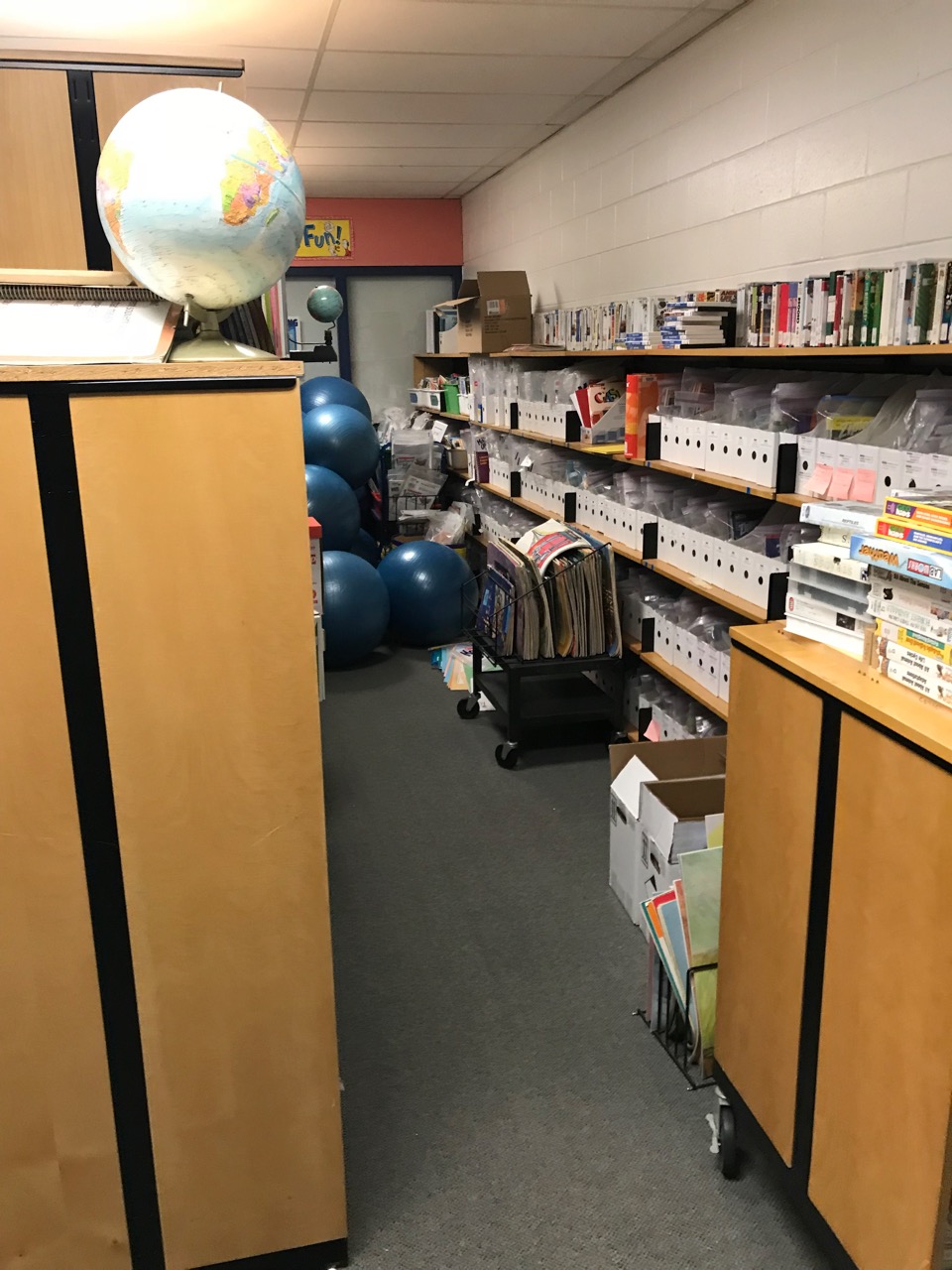
When I first saw the Learning Commons at St. Elizabeth Ann Seton, I saw an amazing space with great potential. Having maker-designed a number of LC spaces previous to SEAS, the vision was instant and very clear. What I thought was needed was micro spaces. Areas were groups of students and/or staff could work collaboratively on a project or activity without disrupting each other. The size of the room was perfect for this design.

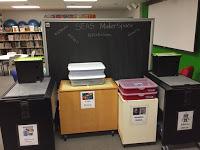
Alexa, their current Library Tech, was keen to get started. She too could see the potential but like many, the task seemed huge and overwhelming for just one person. What she needed to know was that she wasn’t alone. The staff had already put together 4 portable MakerStations - Robotics, Lego, Invention and Audiovisual. All were loaded with perfect resources and ready to roll. We had a plan and with some assistance and muscle we were ready to dig in.

Books were moved and grouped together in common areas. Teacher resources were moved to a more out of the way space were staff could work collaboratively in private, close to the needed materials. Shelves were arranged to make area dividers. Tables were moved out. Too much furniture can impede with the need for open spaces that play, tinkering and exploration require. The furniture that was kept was set up in such a way that is was flexible to allow for large group meetings or small separate work spaces. In 6 hours...Voila...a new space that met all of the needs of the staff, students, Learning Commons and MakerSpace.

Thank you for letting me be a part of your Maker transformation journey.


Michelle Sherwin 
(Library Tech at Our Lady of Peace and St. Luke's Ottawa)
BEFORE


AFTER


Thursday, 15 February 2018

Maker Mobile

While the finished product was our main goal, so much more came out of our afternoon of creating our maker mobile. A lot of research was required into what we would need to create our 4 carts. Through our TLLP budget we were able to purchase many of the necessary items such as Lego, microphones, tripods, makey makey, chromebooks, iPads, Tech Tubs etc. With the help of a Library Technician from another school (Michelle Sherwin) who has put together many carts we came up with a plan. Our job was to convert 4 pieces of furniture into 4 Maker Mobile Carts.


The hardest job was gutting an old netbook cart. A hammer was needed and a few cuts and bruises were had, but the satisfaction Nadia and I got from taking out almost every piece in order to create something from nothing was worth it. We turned the netbook cart into the Robotics Station because we were able to lock up the valuable items such as the Ozobots, Beebots, Sphero and Dash & Dot.
The Lego Station was converted from a wooden Library poster cart. They were able to secure Lego boards to the outside and store the Lego in 4 bins on the inside. We converted a portable desk into the Invention Station. We collected a lot items from staff and students and purchased the basics such as storage bins, scissors, markers, and tape to finalize it.


Lastly, Laura and Michelle repurposed an old wooden desk by attaching wheels, a lock to secure the more valuable items and removed another section in order to store the tech tub filled with chromebooks and iPads.


The best part of the day was the communication and teamwork that went into making these 4 carts and realizing a year long dream of bringing Maker Mobile stations to SEAS. There was great satisfaction in having a physical end product at the end of our afternoon together.


~ Juliana Lacelle